
Centuries beside the Nevėžis: Labūnava and its church
The history of Labūnava stretches back far beyond its first church. The parish worships today in the former Zabiela family chapel, where the stories of this land, a noble family and a community of faith meet.
Explore the history
Life here began long before the first church
Labūnava’s past reaches back to a time before today’s settlement, manor or parish existed. People lived in the valleys of the Nevėžis, Barupė, Urka and nearby rivers from prehistoric times. Archaeologists have found traces of early settlements and burial places in Graužiai and Pakapiai. Flint tools, pottery fragments and other traces of early life have been discovered in the area; some settlements may date to the Mesolithic period.
The burial grounds of Labūnava, Graužiai and Pakapiai show that this area has been inhabited for many centuries. Burials investigated at Labūnava date to the fifth and sixth centuries; weapons from later periods have also been found nearby. Some discoveries were preserved in local school collections and others eventually reached the Kėdainiai Regional Museum.
Much of the old landscape was altered in the twentieth century by river engineering, land drainage and gravel extraction. Vaidas Banys describes the damming of the Barupė–Urka confluence valley in 1980, part of an area linked to the earliest settlement of Labūnava. These changes make it difficult today to place every archaeological find in its original setting.
The earliest written mention of Labūnava
In 1364, the name Labūnava appears in chronicles of the Teutonic Order; the Latin name terra Labuno — “the land of Labūnava”. This is among the earliest known written references to the area.
Accounts of the Order’s campaigns discussed by Vaidas Banys describe strong forest barriers protecting the lands around Labūnava in the fourteenth century. They hindered enemy movement; during the campaign of 1364, the Teutonic Knights dismantled and burned some of them. Banys links these reports to a broader defensive barrier system that may have extended through the neighbouring forests. Its precise location and extent are reconstructed from historical texts and the landscape rather than confirmed directly on the ground.
Old accounts also speak of a castle at Labūnava. The nineteenth-century traveller Teodor Triplin wrote that the manor might have stood on the site of an older castle. No archaeological evidence has yet confirmed the existence of a specific castle there, however, so this remains a historical hypothesis.
Burial grounds, horses and silverwork
Archaeological research in nearby Graužiai and Pakapiai began in 1938–1939. Scholars associated with work in this area include Jonas Puzinas, Regina Volkaitė-Kulikauskienė, Pranas Baleniūnas and Vytautas Urbanavičius. Their findings shed light on the early inhabitants, their burial customs and links with other lands.
Horse burials are among the most striking features of central Lithuanian cemeteries. Horses were buried in Graužiai, Pakapiai and Ruseiniai, sometimes with bridles, bits and richly decorated harness fittings. Vaidas Banys notes that these finds reflect the status of warriors and the important place of the horse in society. Some harness fittings were silvered or decorated with small bells.
Remarkable twelfth-century silver objects were discovered at Graužiai in 1969, including a sword-scabbard fitting and a twisted silver neck ring weighing almost a kilogram. Evidence of jewellery-making was also found: small weights, raw metal and finished ornaments. These objects suggest skilled craftspeople, trade connections and relatively prosperous communities in the Nevėžis valley.
The ancient cemeteries still raise questions for researchers: why did funerary rites differ for women and men, how were cremation burials arranged and what part did nearby rivers play? A cremation cemetery near Sengynė, together with old place-names such as Alkupis, Gojus and Vėrupė, has prompted suggestions about pre-Christian sacred sites. Some of these interpretations remain scholarly hypotheses, not established facts.
Water shaped the historic landscape. The Nevėžis, its tributaries, fords and old roads connected communities on either side of the river. Vaidas Banys suggests that Graužiai, Pakapiai and Labūnava may have formed a connected network of settlements and burial grounds. Its precise layout remains a subject for further research.
The Labūnava manor and the Zabiela family
The Labūnava manor is known from written records dating to the sixteenth century. In the eighteenth and nineteenth centuries it belonged to the Zabiela family. The present Church of Divine Providence is closely linked with them: the building was originally intended to commemorate and bury members of their family.
The Zabielas belonged to the world of landed families around the Nevėžis. They were related to the Prozor family, and other noble families also lived nearby. Although the Zabiela name is particularly associated with Apytalaukis, Vaidas Banys notes that Labūnava was also regarded as one of their ancestral homes.
Labūnava’s past also touches the world of literature. In 1922, Maurice Prozor and the poet and diplomat Oscar Miłosz, both connected with noble families of the area, visited the region. Miłosz drew on images of the Nevėžis valley, family memories and local legends in his literary work. These stories form part of the cultural memory of the region, though literary legends are not direct evidence of historical events.
From a wooden church to the Zabiela chapel
The first wooden church in Labūnava was built in 1799 by the landowner Ignotas Zabiela. It did not survive: the church burned down in 1812. Anupras Zabiela, heir to the manor, built a new church after the fire.
In 1855, the parishioners of Labūnava and Fr J. Normantas built a new masonry church.
In 1859, Countess Matilda Kobylinska-Zabielienė built a mausoleum chapel for the Zabiela family in the Labūnava cemetery. Members of the family were buried there, and their remains still rest in the vault beneath the building.
In 1944, towards the end of the Second World War, the church in Labūnava was destroyed by fire. 1945, the Zabiela mausoleum chapel in the cemetery was adapted for use as the parish church. A building first intended as a family burial place became a house of prayer for the entire parish.
According to the parish history, the bell tower, spared by the fire, was moved to a corner of the cemetery. Statues of the Sacred Heart of Jesus and the Blessed Virgin Mary were placed beside the new church entrance; they had formerly stood by the church that burned down.
A circular dome and Classical architecture
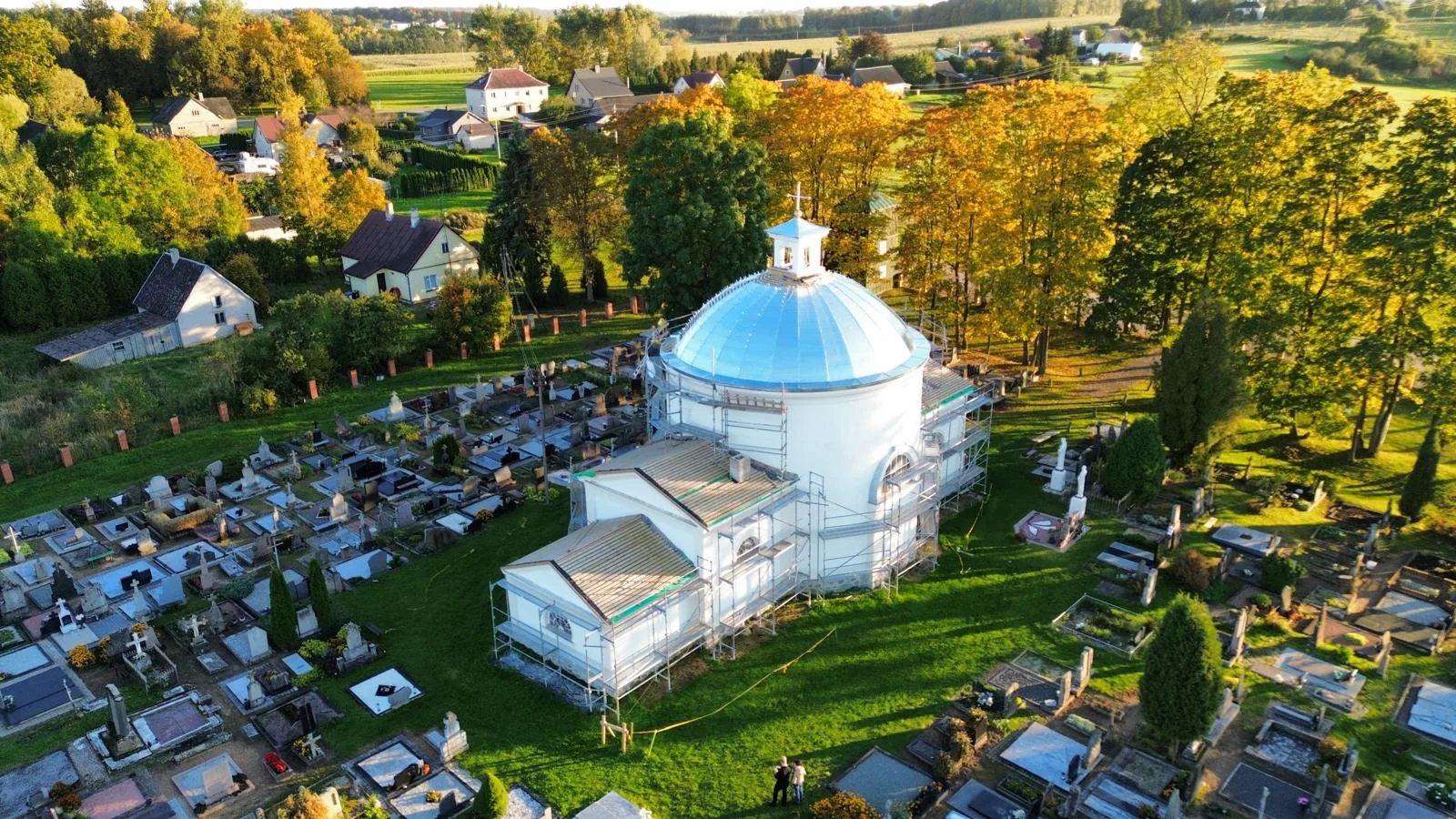
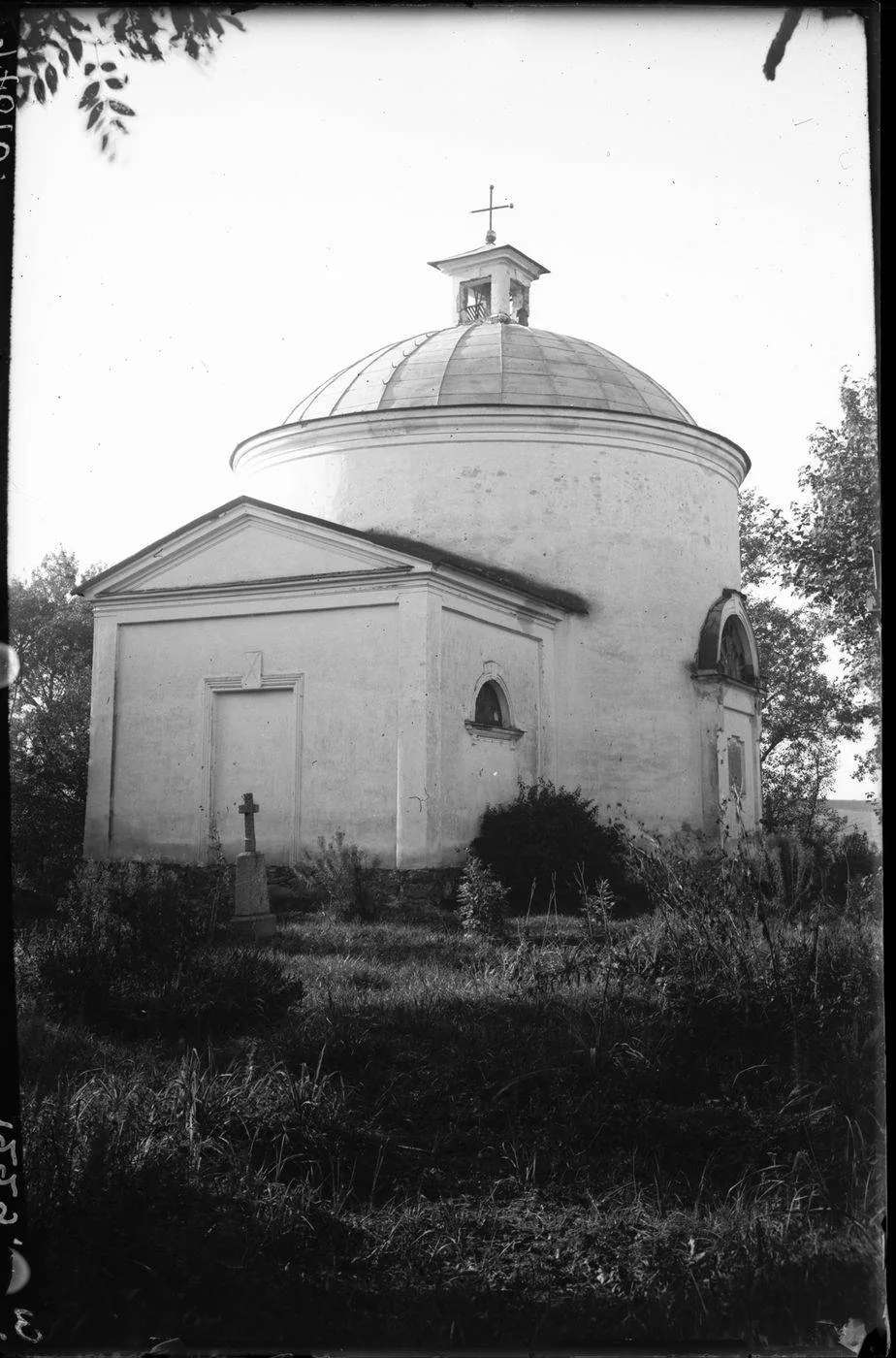
The Church of Divine Providence in Labūnava is a late Classical building. At its heart is a circular space—a rotunda—covered by a dome around ten metres in diameter, with a small lantern and cross above. The entrance porch and chancel adjoin the central section; a sacristy was added beside the chancel after the war.
Surviving architectural drawings reveal the proportions and plan of the chapel. They show the wings adjoining the round centre, the shapes of the windows, the entrance and the stairs leading down to the crypt. Many of these features can still be recognised in the building today.
Inside the church are three altars—the high altar and two side altars—and an organ loft. Stained-glass windows were installed in 1984. Beneath the church are six sealed burial chambers of the Zabiela family. Vaidas Banys also describes the crypt and memorial plaques marking the burials, a reminder of the building’s original purpose.
The parish’s living historical memory
Through the efforts of parish priest Steponas Pilka (1917–1994) , two monuments were erected near the church: a monument to Vytautas the Great in 1987 and a monument to St Casimir in 1988 . They recall both the history of the region and its Christian tradition.
The parish boundaries were redefined by Decree No. 179 of 1 April 2003, issued by Sigitas Tamkevičius, Metropolitan Archbishop of Kaunas. The parish includes Labūnava and neighbouring villages; more information is available on the parish page.
The history of Labūnava church does not end with its archival documents. Its dome, façades and surroundings are cared for today as well. You can be part of that work by supporting the preservation of the church.
Milestones in the history of Labūnava and its church
5th–6th centuries
Burials dating to this period have been found in the Labūnava cemetery.
1364
The name Labūnava is recorded in the chronicles of the Teutonic Order.
16th century
The Labūnava manor appears in written records.
1799
Ignotas Zabiela builds the first wooden church.
1812
The church burns down; Anupras Zabiela builds another.
1855
The parishioners and Fr J. Normantas build a new masonry church.
1859
The Zabiela family mausoleum chapel is built in the cemetery.
1944–1945
The parish church burns down in 1944; the Zabiela chapel becomes the parish church in 1945.
1987–1988
Monuments to Vytautas the Great and St Casimir are erected.
Today
The church continues to be cherished as an important part of parish life and local heritage.
Historic photograph and architectural drawings
The old photograph shows the chapel before later changes. Surviving architectural drawings reveal its proportions, the shape of the dome and the stairs leading down to the family burial vault.
Architectural drawings of the Labūnava chapel
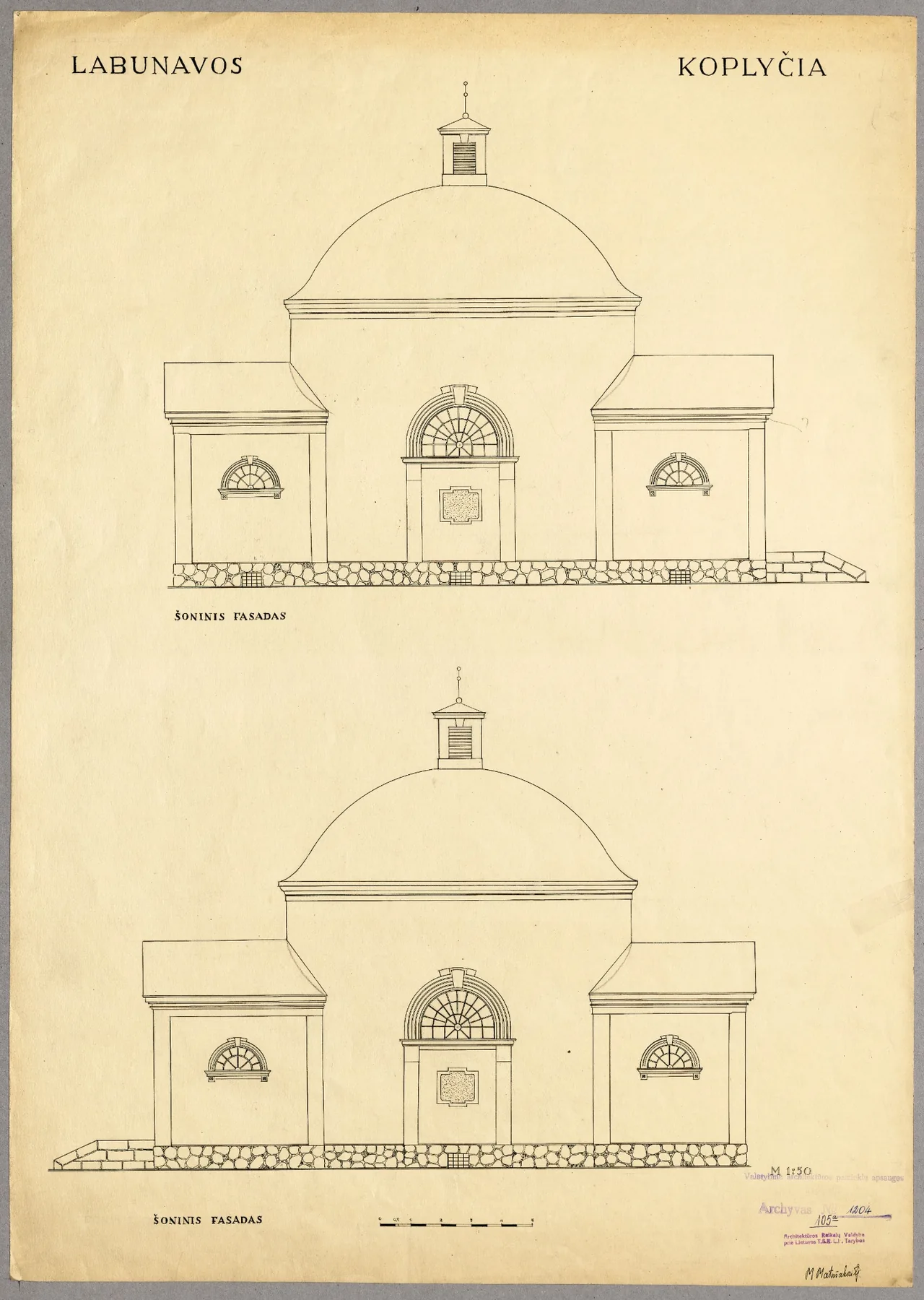
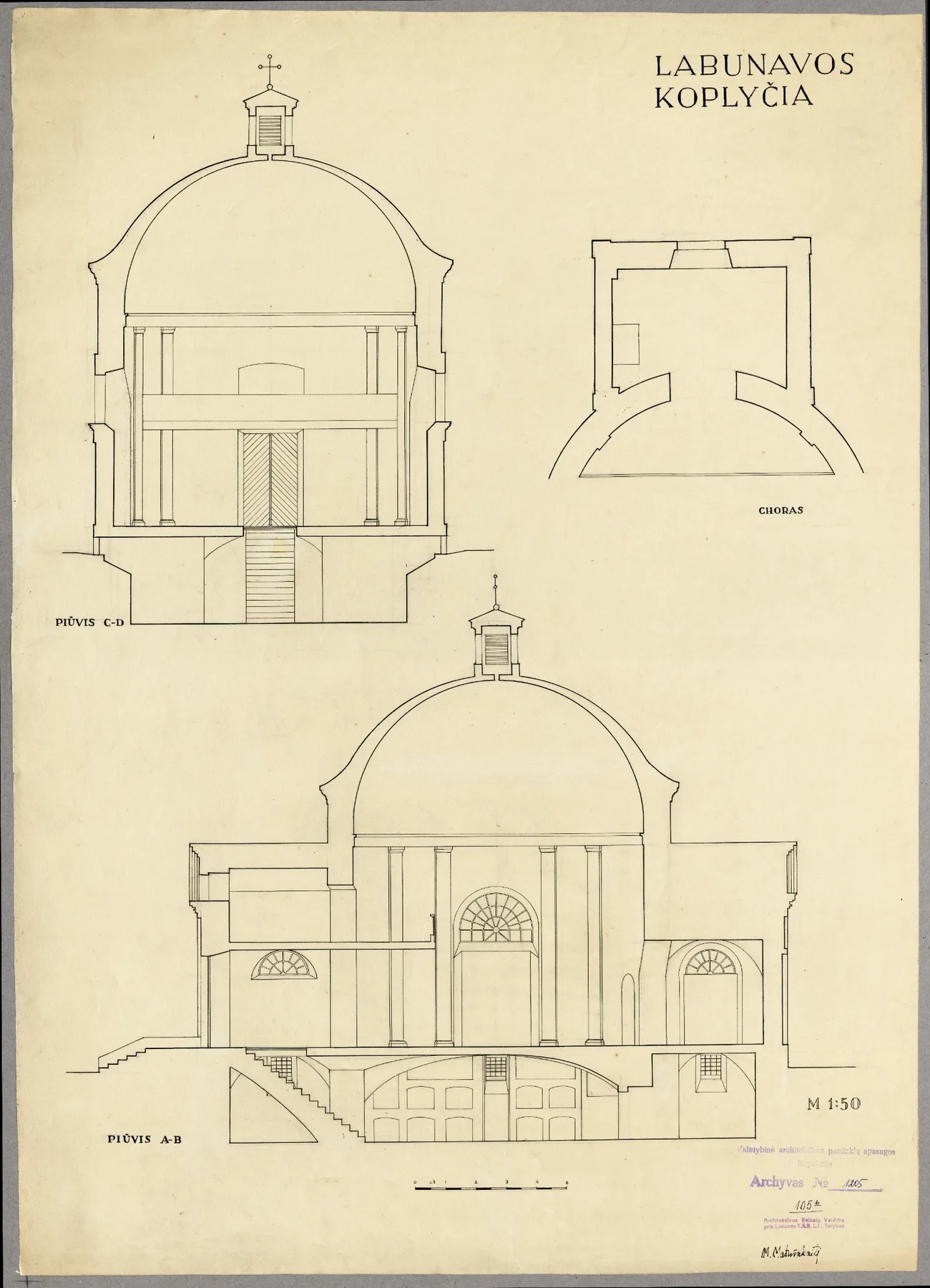
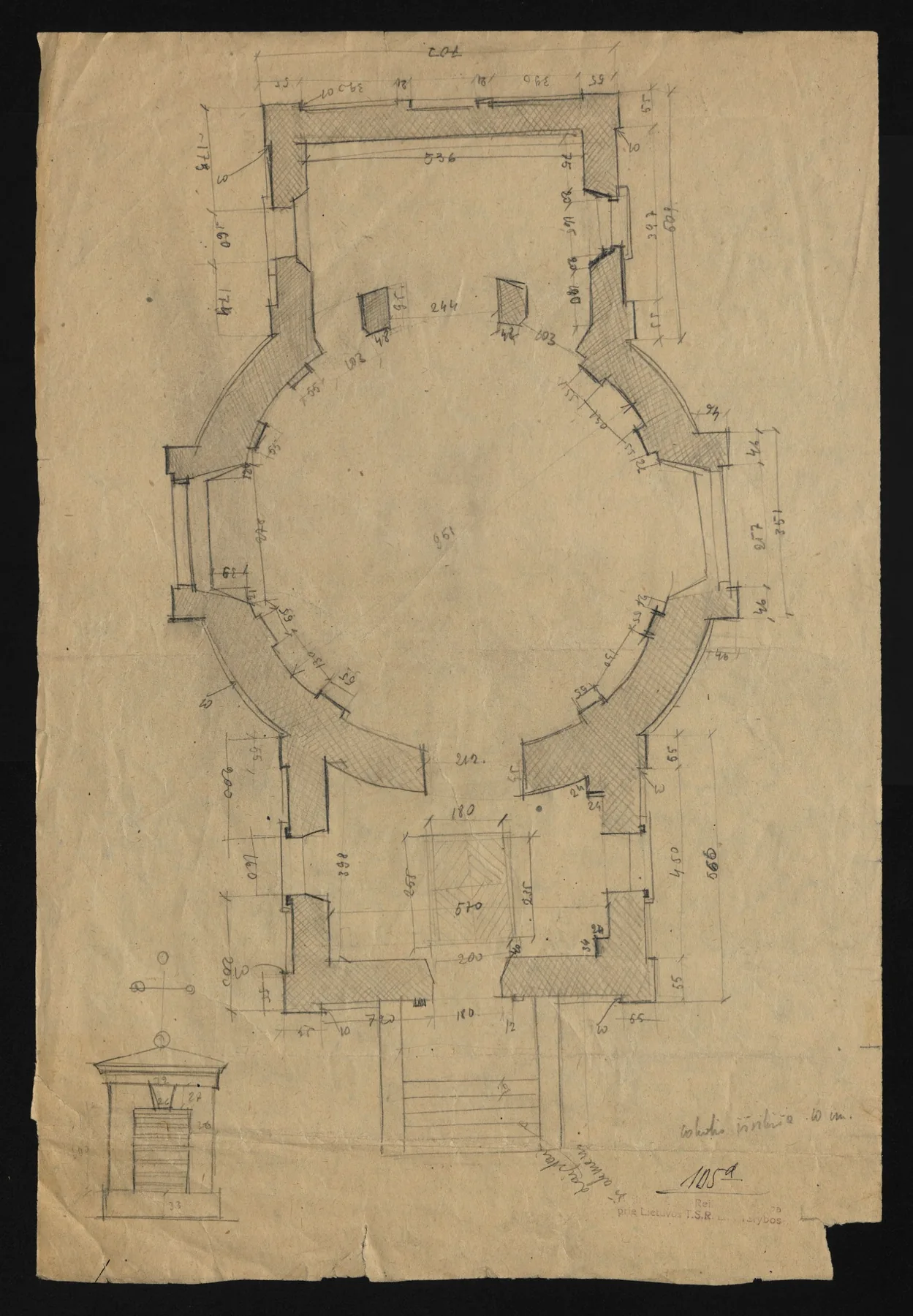
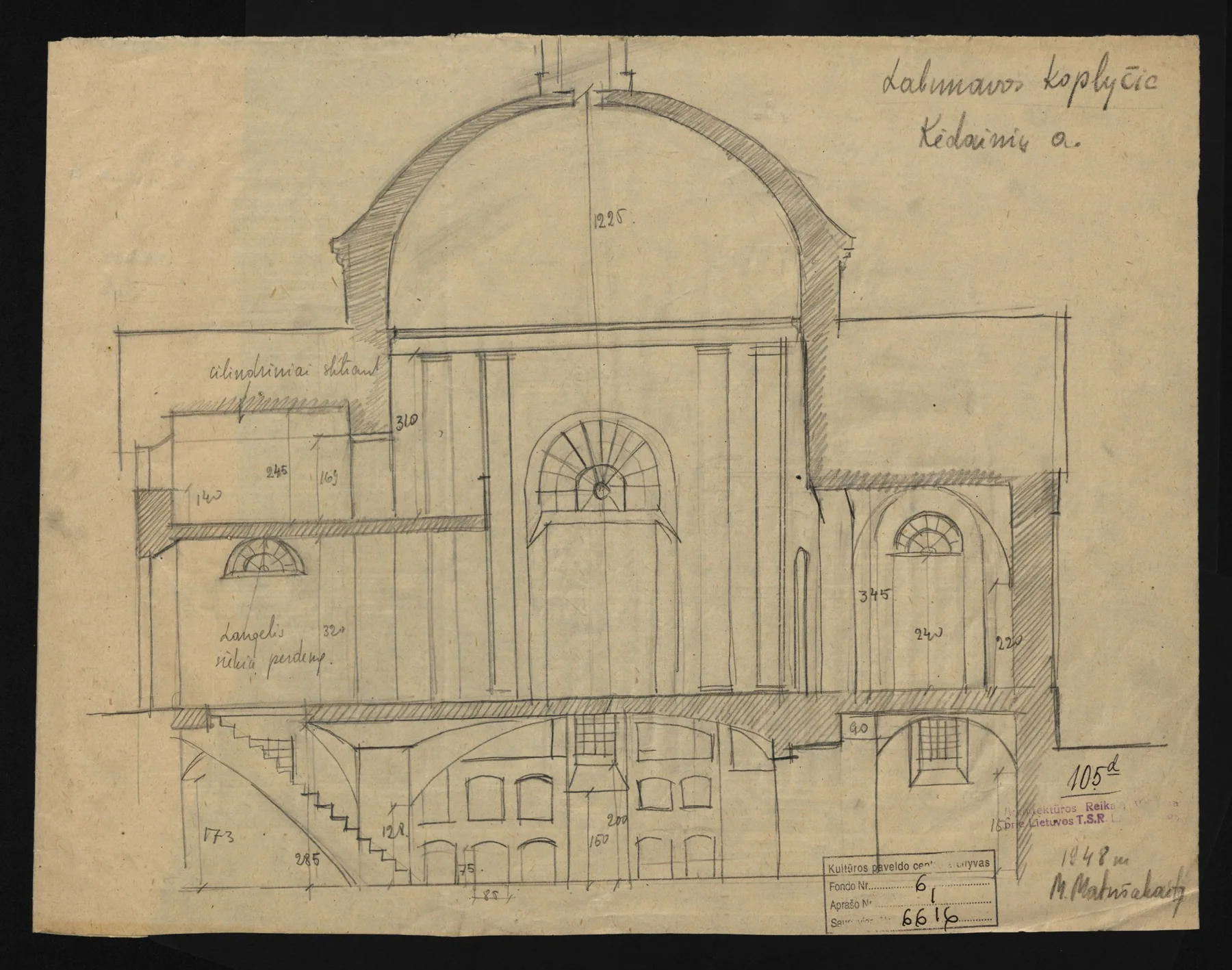
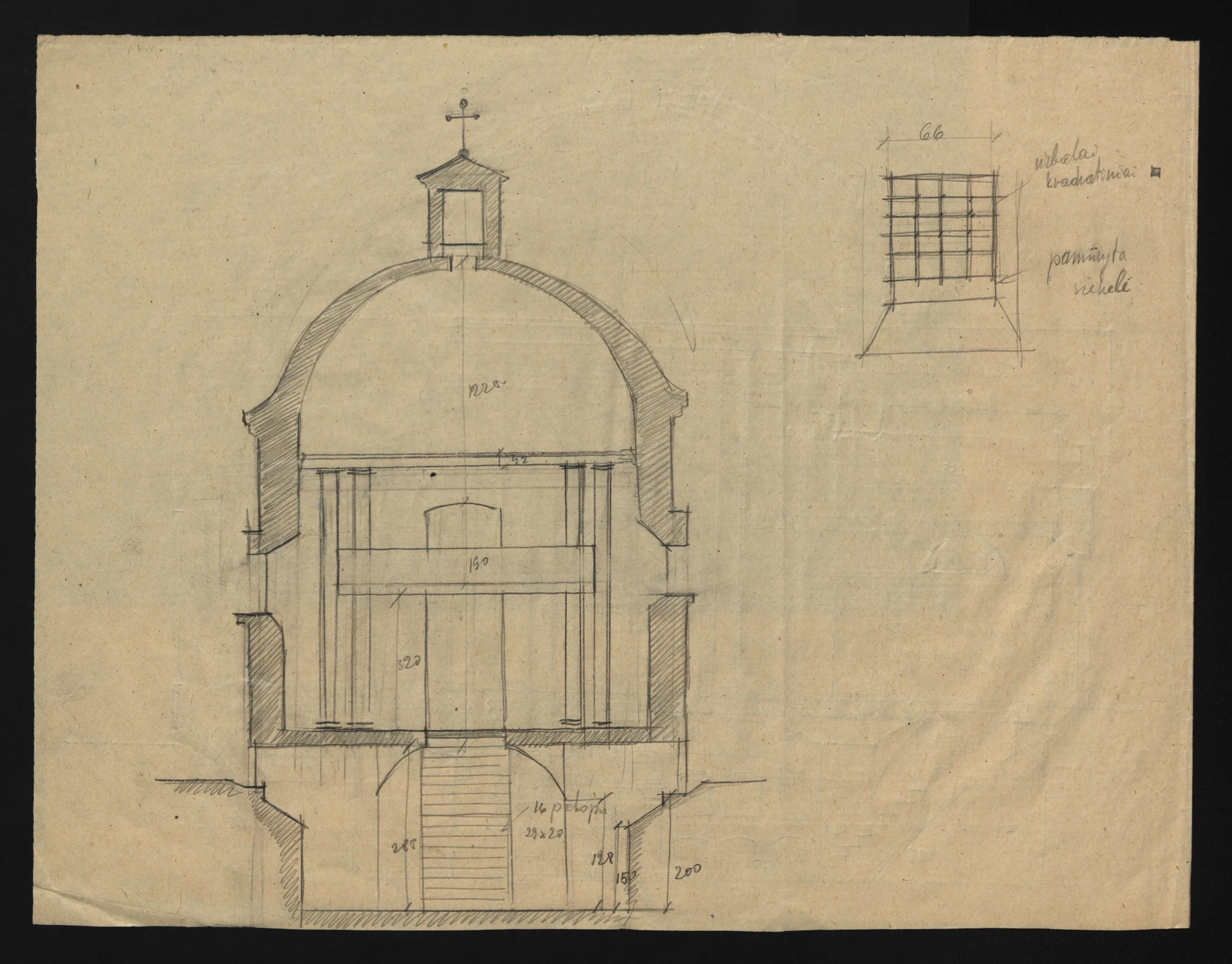
The drawings retain their original archival inscriptions and stamps.
Historical sources
- Vaidas Banys, Kėdainiai Regional Museum. “Labūnava: mysteries of a forgotten ‘county’”, Part I: “Romantics, prophets and researchers of the Valley of Legends” (article in Lithuanian). Rinkos aikštė, 19 January 2023.
- Vaidas Banys, Kėdainiai Regional Museum. “Labūnava: mysteries of a forgotten ‘county’”, Part II: “Between mythic realms and archaeological ground” (article in Lithuanian). Rinkos aikštė, 27 January 2023.